
Industrial O-ring seals for hydraulic, automotive and industrial applications
Use this guide to narrow down suitable O-ring materials, compare product lines and match the application with the relevant industry route: NORMATEC for broad industrial use, HITEC for approval or documentation-sensitive applications, and FFKM or FEP-based solutions for demanding chemical, process and pharma environments.
New to APSOparts? Create your free account and start your sealing journey with us.
Use this guide to narrow down suitable O-ring materials, compare product lines and match the application with the relevant industry route: NORMATEC for broad industrial use, HITEC for approval- or documentation-sensitive applications, and FFKM or FEP-based solutions for demanding chemical, process and pharma environments.
- Broad industrial assortment: NORMATEC covers general O-ring requirements across standard industrial applications.
- Certified or documented product routes: HITEC, selected Evolast and Kalrez compounds, and FEP-O-Seal can support applications with approval, documentation or process requirements, depending on the exact article, compound and certificate.
- Industry-oriented selection: Start with the target industry, then validate material, required approvals or documentation, dimensions, article-level data and availability.
QUICK SELECTION
Select O-rings quickly and easily
Use this first-step finder to start with the most relevant operating condition. Before ordering, verify the exact compound, dimensions, required approvals or documentation and product data on the selected article.
What does your O-ring need to handle?
Choose the main condition and sealing movement. The result provides a technical shortlist starting point, not a final product release.
Main operating condition:
- Standard industrial oils, fuels or hydraulics
- High-temperature environment
- Water, steam, weather or ozone
- Aggressive chemicals / solvents
- Extreme chemical and temperature conditions
- Very low temperature / food-grade flexibility
- Higher heat and mechanical load
Sealing movement
- Static seal
- Dynamic seal
Use the suggested starting material as a shortlist only, then confirm dimensions, compound, required approvals or documentation, service limits and application conditions on the selected product page.
Search by material
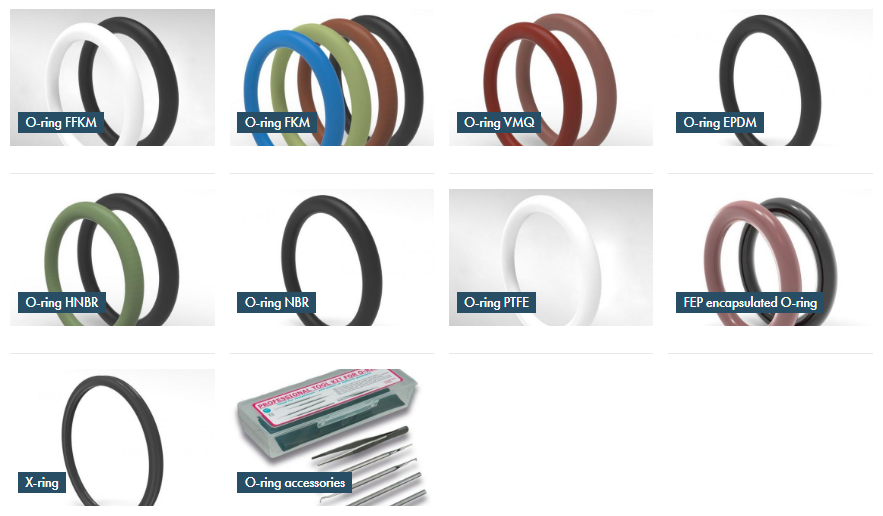
Start with NBR, FKM, EPDM, HNBR, VMQ, PTFE or FFKM.
Search by size
Use inside diameter, cross-section and applicable standards to identify a matching O-ring.
Search by application
Match the seal to your medium, temperature, movement and installation environment.
Search by temperature
Filter candidates by the expected operating range and check the exact compound limits.
Search by application
Match the seal to your medium, temperature, movement and installation environment.
Search by temperature
Filter candidates by the expected operating range and check the exact compound limits.
MATERIAL OVERVIEW
| Material | Key properties | Requirement | Typical industrial applications | APSOparts product route | Alternative route to check |
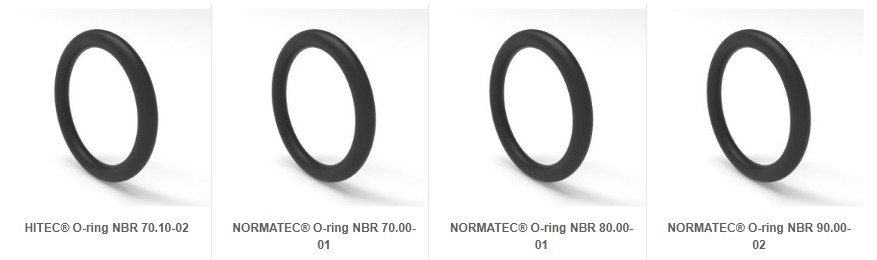
| NBR | Good oil and fuel resistance, cost-effective, good mechanical strength and a moderate temperature range. | General industrial oils, fuels or hydraulics. Approval- or documentation-sensitive sealing route for controlled applications | Hydraulic systems, pneumatic seals, automotive fuel systems, industrial machinery. | NORMATEC for general industrial applications; HITEC NBR where defined approvals or documentation are required, subject to article and compound verification. | For more heat, ozone, UV or wear resistance, review HNBR. For high temperature and aggressive chemicals, review FKM. |
| FKM | High heat and chemical resistance; typically resistant to oils, fuels, solvents and ozone. | Approval- or documentation-sensitive sealing route for controlled applications. High-temperature or chemically demanding elastomer sealing | Chemical processing, automotive engines, high-temperature sealing, oil & gas, process and advanced manufacturing. | NORMATEC for general FKM applications or HITEC FKM where defined approvals or documentation are required; review Evolast or Kalrez FFKM for more extreme exposure, with approvals checked by exact compound and article | For extreme chemical exposure, check FFKM. For a PFAS-free or more cost-sensitive route, HNBR can be checked, but with lower chemical and temperature capability. |
| EDPM | Strong water, steam, weather, ozone and polar chemical resistance; poor oil and fuel resistance. | Approval- or documentation-sensitive sealing route for controlled applications. Water, steam, weather and ozone | Drinking-water systems, food & beverage, brake systems, HVAC, outdoor sealing and water-exposed applications. | NORMATEC for general EPDM applications; HITEC EPDM where defined approvals or documentation are required for drinking water, food & beverage, process, pharma or medical applications, subject to article and compound verification. | For a wider temperature range or low-temperature flexibility, check VMQ. For oil or fuel resistance, EPDM is usually not the right base material. |
| VMQ | Very wide temperature capability, excellent low-temperature flexibility and suitable food-grade options depending on the compound. | Approval- or documentation-sensitive sealing route for controlled applications. Very low temperature or flexible food-grade applications | Food & beverage, medical, electronics and static sealing applications. | NORMATEC for general VMQ applications; HITEC VMQ where defined approvals or documentation are required, subject to article and compound verification. | For oil, fuel or chemical exposure, check FKM. For water, steam and weather exposure with a more economical route, check EPDM. |
| HNBR | Improved heat, ozone, UV, abrasion and mechanical resistance compared with NBR. | Higher heat and mechanical load, with improved ozone, UV and abrasion resistance compared with NBR. | Automotive air conditioning, oil and gas, refrigerants and heavy-duty hydraulic systems. | NORMATEC for general industrial applications. | Use when NBR is not robust enough; check FKM if chemical exposure or temperature requirements exceed HNBR limits. |
| PTFE | Very low friction, outstanding chemical resistance and a very wide temperature range; non-elastic material behavior. | Aggressive chemicals in static sealing positions (for non-elastic chemical sealing) | Chemical seals, valve seats, food and pharmaceutical equipment, low-friction applications. | NORMATEC PTFE for general industrial use; check FEP-O-Seal for encapsulated O-ring construction where suitable. | Validate groove design and sealing movement because PTFE does not behave like an elastomeric O-ring. |
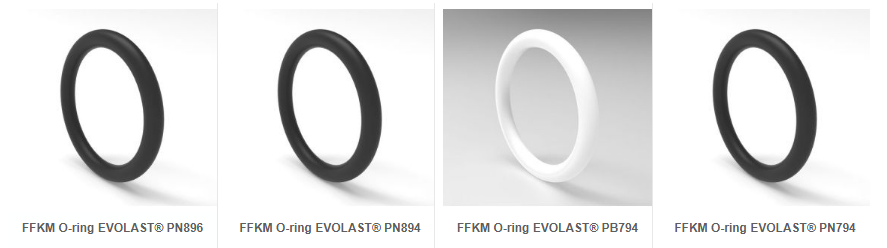
| FFKM | Very high chemical and temperature resistance among elastomers; premium material for demanding conditions. | High-temperature or chemically demanding elastomer sealing | Chemical processing, petrochemical production, oil & gas, energy, pharma, process, food and advanced manufacturing. | Evolast FFKM or Kalrez FFKM for high-performance elastomer sealing in severe chemical and thermal conditions; required approvals must be checked by exact compound, grade and article. | For static chemical sealing, FEP-O-Seal may be checked as a lower-cost route, but not as a direct substitute for dynamic or high-pressure requirements. |
| FEP-encapsulated | Chemically resistant outer layer with an elastomeric core; useful in selected static sealing positions. | Aggressive chemicals in static sealing positions (o-rings where a chemically resistant jacket with elastomeric core is required). | Pharma, chemical and process applications. | FEP-O-Seal O-rings. | Check pressure, movement, compression recovery and installation limits carefully. |
| Material | Key properties | Requirement | Typical applications | Alternative to check |
|---|---|---|---|---|
| NBR |
|
|
|
|
| FKM |
|
|
|
|
| EPDM |
|
|
|
|
| VMQ |
|
|
|
|
| HNBR |
|
|
|
|
| PTFE |
|
|
|
|
| FFKM |
|
|
|
|
| FEP-encapsulated |
|
|
|
|
Temperature ranges, chemical resistance, approvals and documentation vary by exact compound and article. Always verify the product-level data sheet, required approvals, documentation and application conditions before replacing one material or product line with another.
APPLICATION CONTEXT
Start from the operating environment
For industrial purchasing, the relevant question is not only what an O-ring is, but where will it be used. The material shortlist should reflect the medium, temperature, pressure, movement and required documentation.
- Hydraulic and pneumatic systems often start with oil and pressure requirements.
- Chemical, food, drinking-water and pharma applications require closer review of media compatibility, required approvals and documentation.
- Maintenance replacements should confirm the dimensions, material, compound, application conditions and any required documentation of the existing seal.
STATIC VS DYNAMIC SEALING
Match the seal to the movement
Static sealing usually focuses on compression, groove design, installation conditions and long-term media compatibility. Dynamic sealing adds friction, lubrication, surface finish, clearance gap, pressure limits and wear to the decision.
For dynamic applications, verify the seal design in more detail before selecting the final product variant.
CORE SELECTION GUIDE
How to choose the right O-ring
Start with the main operating condition, then check temperature, media, movement, dimensions and technical documentation before selecting the final product variant.
Quick answer
Start with a direct material recommendation based on the main operating condition.
- NBR: commonly used for standard oil and fuel applications.
- FKM: often recommended for higher temperatures and broader chemical resistance.
- EPDM: suited to water, steam, weather and ozone exposure.
- VMQ: useful for very low temperature flexibility or suitable food-grade options.
- HNBR: an upgrade path from NBR where higher heat, ozone and mechanical resistance are required.
Use this as a material shortlist only; final selection depends on compound-specific data, required approvals or documentation and application limits.
Guided selection
Compare the actual application requirements before adding a product to the cart.
- Operating temperature
- Medium and concentration
- Static or dynamic movement
- Size, groove and installation space
- Required approvals, documentation, availability and required quantity
Technical validation
Confirm technical suitability before release in critical or demanding applications.
- Pressure and extrusion risk
- Shore hardness and compression
- Service life and maintenance interval
- Standards, dimensions and tolerances
- Compound-specific data sheet
- Approval and documentation requirements: verify the exact product route, article, compound and approval level where relevant.
TECHNICAL PARAMETERS
Technical parameters at a glance
Material labels alone do not guarantee performance. Use the product data and installation conditions to validate the correct O-ring.
Temperature range
Compare expected minimum and maximum temperature with the compound-specific range. VMQ often supports very low temperatures, EPDM is strong in water and steam contexts, while FKM/FFKM are considered for higher heat.
Shore hardness
Hardness influences extrusion resistance, compression behavior and assembly. Select it together with pressure, groove geometry and whether the seal is static or dynamic.
Chemical resistance
Check medium, concentration, operating temperature and exposure time. EPDM is not suitable for oils and fuels; FKM, FFKM, PTFE or FEP-encapsulated options may be relevant for stronger chemical exposure; however, PTFE behaves as a non-elastic sealing material and FEP-encapsulated constructions should be checked against static sealing, installation and pressure limits.
Pressure resistance
Pressure capability depends on material, hardness, clearance gap, movement, groove design and possible back-up rings. FEP-encapsulated options require particular care in pressure, installation or dynamic applications because elasticity and recovery depend on the encapsulated construction and core material.
STANDARDS & DOCUMENTATION
Certificates and compliance
Technical requirements differ by industry. Product-level approvals, declarations, certificates and data sheets help you validate the exact compound and approval level they are purchasing.
Standards, dimensions and quality assurance
Use recognized standards to compare dimensions and simplify sourcing across replacement, maintenance and new-build applications.
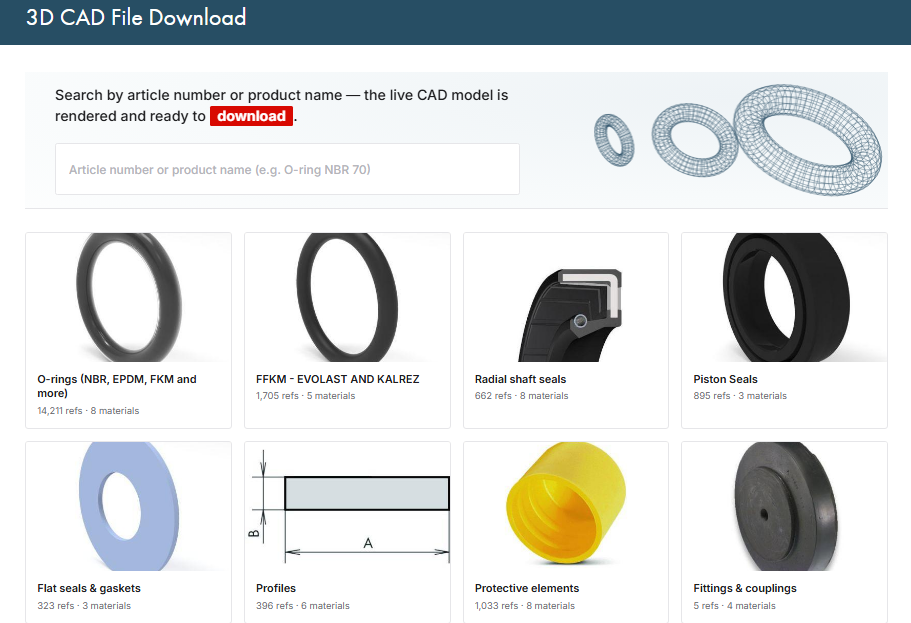
- ISO 3601 is commonly used for O-ring dimensions, tolerances, housing dimensions, quality acceptance criteria, back-up rings and material suitability; AS568 is commonly used for inch-size O-rings.
- Check dimensions, tolerances, groove or housing dimensions and specification requirements against the selected product variant and article-level data.
- For controlled applications, check whether the exact article, compound or grade provides the required approvals, declarations, certificates or documentation, for example within HITEC, selected Evolast or Kalrez grades, or FEP-O-Seal.
- Where NORMATEC and HITEC variants exist, check whether the application requires defined approvals, documentation or a specific approval level before selecting or substituting the article.
FREQUENTLY ASKED QUESTIONS
Which O-ring material is best?
The best O-ring material depends on temperature, medium, pressure, movement, required approvals or documentation, and application. NBR is commonly used for standard oil and fuel applications, FKM for higher heat and broader chemical resistance, EPDM for water and steam, VMQ for low-temperature flexibility, and FFKM for extreme chemical and temperature conditions.
Which APSOparts O-ring product line should I review?
Review NORMATEC for general industrial applications, HITEC for approval- or documentation-sensitive applications where the exact article and compound provide the required approval level, Evolast or Kalrez for high-performance FFKM sealing, and FEP-O-Seal for suitable static pharma, chemical or process applications.
Which industries are covered by the top O-ring products?
The product overview includes general industrial applications, drinking water, food & beverage, process, pharma, medical, chemical processing, petrochemical production, oil & gas, energy, industrial machinery and advanced manufacturing.
Can FEP-O-Seal replace FFKM?
FEP-O-Seal can be considered for suitable static sealing positions in aggressive chemical, pharma or process environments where a FEP-covered construction with an elastomeric core fits the design. It is not a general replacement for FFKM, especially where pressure, elasticity or dynamic sealing performance is critical.
Can I switch from NORMATEC to HITEC O-rings?
If the base material is the same, customers using NORMATEC can generally review the corresponding HITEC O-ring as an approval- or documentation-oriented upgrade route. The reverse should not be assumed where defined approvals, documentation or a specific approval level are required, because a NORMATEC item may not provide the required approval level.
Open the O-rings / X-rings category in the APSOparts online shop and buy the O-rings now!